In mid-November 2025, a monarch butterfly wearing a solar-powered tag lighter than a tenth of a gram left Moran Lake. Two days later it turned up in Cambria, more than 100 miles down the coast. Another tagged butterfly, LF006, went the other way. According to the Xerces Society, it was detected inland at lesser-known overwintering sites on the UC Santa Cruz campus and in the surrounding neighborhoods.
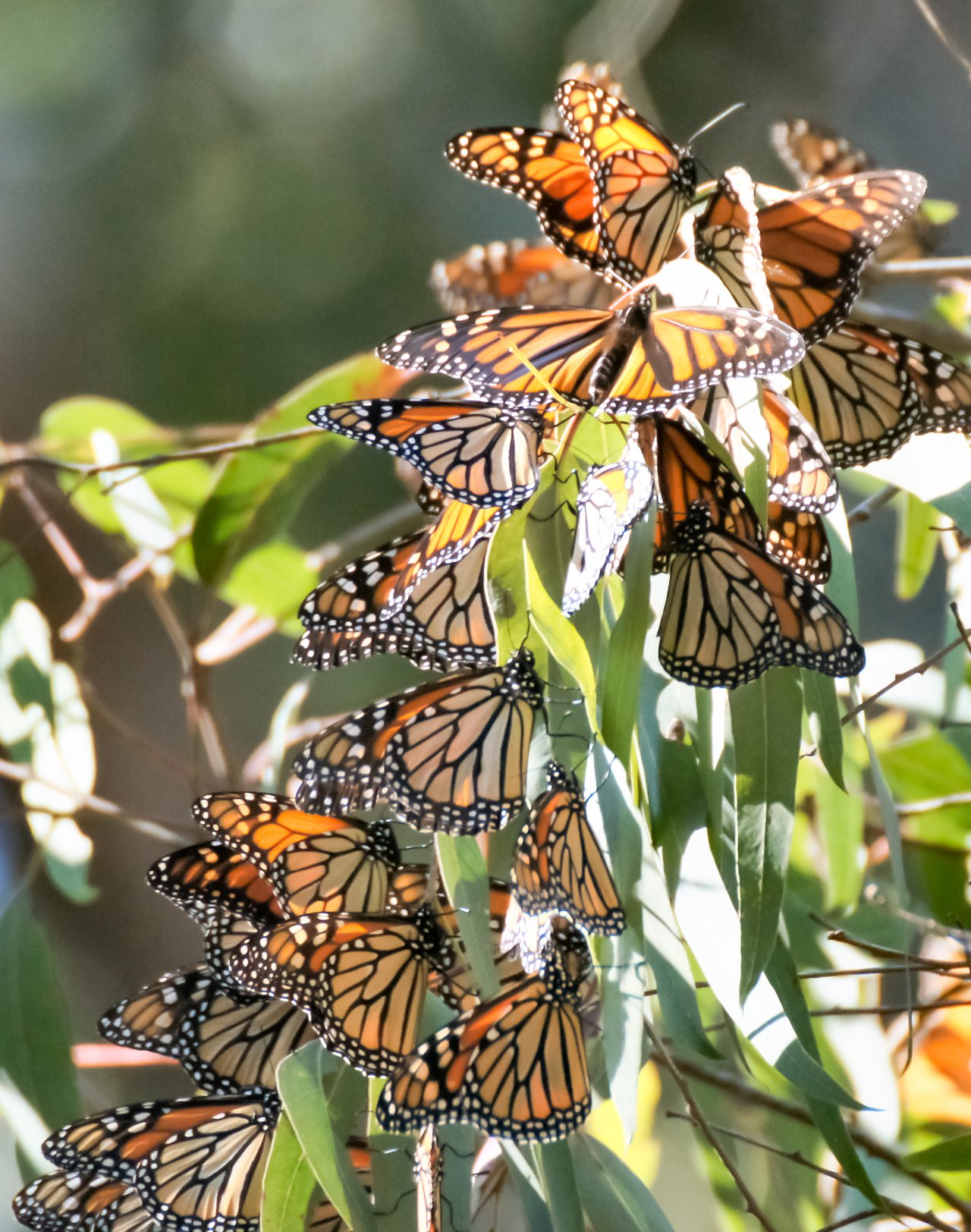
The Natural Bridges grove is where Westside monarchs cluster, and they spend their winter days moving through the same streets, campus and yards as everyone else on this side of town. This is the first full monarch season since those tracking results came out, and the grove is still the place to see the clusters. The habitat around it reaches much farther.
Two Westside groves and the numbers behind them
The Xerces Society names three sites as the most important monarch overwintering areas in Santa Cruz County: Natural Bridges State Beach, Lighthouse Field State Beach on West Cliff Drive, and Moran Lake County Park. In recent years these three have held the highest numbers of overwintering monarchs anywhere on the California coast. Two of the three are on the Westside, and both are open to the public.
Site | Where | Park hours | Monarchs counted, 2025–26 season |
|---|---|---|---|
West end of West Cliff Drive | 8 a.m. to sunset | 1,100 on Oct. 29, 2025; 2,500 in early December 2025; 1,540 in the late-season count | |
West Cliff Drive | 6 a.m. to sunset; parking lot 8 a.m. to sunset | 979 as of Nov. 1, 2025; 804 in the late-season count |
Those 2,500 monarchs at Natural Bridges in early December 2025 were the highest count at any Santa Cruz County site in the Xerces Thanksgiving count. The statewide picture is much thinner. Volunteers counted 12,260 western monarchs at 249 sites during the 2025 Thanksgiving count. That was the third-lowest total since counting began in 1997. Only 2020, with 1,901, and 2024, with 9,119, came in lower. By the late-season count, which closed January 11, 2026, the statewide figure had fallen to 6,464 monarchs across 193 sites, 47 percent below the midseason total.
That Thanksgiving, one Westside grove held about a fifth of every monarch counted in California. With so few butterflies left, where they spend their winter days counts for a lot, and the tags showed that the answer covers more ground than the two parks.
What the tags showed about the rest of the neighborhood
In mid-November 2025, the Xerces Society and Point Blue Conservation Science worked with California State Parks and Santa Cruz County Parks to attach tiny BlūMorpho transmitters to monarchs at Natural Bridges, Lighthouse Field and Moran Lake. Cellular Tracking Technologies built the tags. Each weighs 0.06 to 0.07 grams and has a small solar panel and a short antenna. Older monarch tags could only be picked up by specialized receivers. These can be detected by any phone or tablet with Bluetooth and location turned on.
The researchers said the early results changed how they think about the grove.
"This study has already shown that overwintering monarchs frequently fly across towns and cities," said Blake Barbaree, senior ecologist with Point Blue, in the Xerces Society's December 2025 announcement. "This underscores how much we can help overwintering monarchs at home and in our communities by planting pesticide-free flowers that provide nectar."
The Santa Cruz Sentinel reported that tagged butterflies had already pinged in Capitola and at Lighthouse Field by early December. In a later update, Xerces reported that a few of the fall-tagged monarchs were still detectable at Central Coast overwintering sites, while others had moved as far as 90 miles inland.
This is where Westside residents come in. Detections come from ordinary phones. The free Project Monarch app has a Scan tool that looks for nearby tags, uploads any detections, and shows other users' detections and tag tracks. Handling and tagging monarchs in California requires a state scientific collecting permit, so the public's part is scanning and reporting. A walk along West Cliff, a coffee near campus or an afternoon in a backyard with the app open could add a data point.
New tags may be coming. The live deployment list on Project Monarch shows a Santa Cruz "Winter 2026" entry with 10 tags marked "Tags in hand." That points to a planned cohort. The list does not show those tags as deployed yet.
The grove itself this fall
Natural Bridges is still where the clusters are easiest to see. California State Parks' events page lists Monarch Butterfly Grove visits from mid-October through December, daily from 11 a.m. to 4 p.m., with volunteer docents on hand to talk about the butterflies. Because the migration varies, the park suggests calling (831) 423-4609 to ask about the current population and docent availability before you go. The park's own page names late October and all of November as often the best time to see the monarchs, and the vehicle day-use fee is $10. The visitor center is open daily from 11 a.m. to 4 p.m. from October 1 through January 31.
The way into the grove has changed. A Santa Cruz Sentinel photo report from January 2026 shows a hand-built walkway winding to the Monarch Grove, with rounds cut from a downed eucalyptus marking the Monarch Trail. The Sentinel calls the grove California's only state monarch preserve, and the walkways and trails are laid out so visitors can watch the butterflies without disturbing them. State Parks also describes an accessible boardwalk leading to an observation deck inside the grove.
That eucalyptus trail marker points to the grove's main management challenge. The Sentinel reported that local conservationists have to balance removing invasive, flammable eucalyptus against keeping the branches overwintering monarchs favor, some of which are eucalyptus. Haley Hernandez, senior park aide at Natural Bridges, told the paper, "Eucalyptus trees have flowers, and that's a food source for them."
Here are the dates still ahead this season:
- October 17 to November 1: the 2026 early-season Western Monarch Count is underway, and no 2026 results have been posted yet.
- Saturday, October 24, 11 a.m. to 5 p.m.: a self-guided Monarch Butterfly tour at Natural Bridges, listed by Visit Santa Cruz County.
- Thursday, November 19, 11 a.m. to 5 p.m.: another self-guided tour date.
- November 14 to December 6: the 2026 mid-season Thanksgiving count window. Last year that count found Natural Bridges at 2,500 butterflies.
The season's opening event, the Welcome Back Monarchs Festival hosted by Friends of Santa Cruz State Parks, took place on October 11 with music, crafts, a parade and a screening of Creating the West Marin Monarch Sanctuary. The send-off is the park's Migration Festival. Last season's was February 14, 2026, and the Sentinel described it as bringing together 30 organizations representing other animal migrations, including ladybugs and whales.
The species also has an open federal question. As of an October 2026 update from Monarch Joint Venture, monarchs have been proposed for threatened status under the Endangered Species Act but are not listed. A proposed settlement filed September 30, 2026 would require a final decision by June 6, 2030, if the court approves it.
The garden half of the habitat
The tracking results matter most at home. Overwintering monarchs aren't dormant all season. The Sentinel reported that they leave their clusters two or three times a week to feed on nearby blooms. When the weather warms around mid-February, they come out of diapause and mate, and the females head inland to find milkweed and lay eggs.
That timing explains the most common planting mistake near the coast. The Xerces Society advises against planting milkweed within five miles of the coast north of Santa Barbara, which covers all of the Westside. These coastal areas are generally outside milkweed's historic range, and planting it here may disrupt migration or overwintering behavior. Xerces recommends nectar plants that bloom in late fall, winter and early spring near overwintering sites instead. The Sentinel added that milkweed too close to the coast can encourage resident monarchs that stay year-round, and these are especially vulnerable to O. elektroscirrha, a parasite that causes crumpled, deformed wings.
The Xerces California nectar plant guide lists several plants that cover the monarchs' winter months:
- Coyote brush: flowers year-round
- Seaside fleabane: blooms from winter into summer
- Manzanita: blooms from winter into spring
- Willow: blooms from winter into spring
County planners are thinking along the same lines at the larger scale. Santa Cruz County's June 2026 habitat plan update for Moran Lake identifies eucalyptus flowers as a nectar source from December through March and says fall nectar helps keep monarchs at the site. Barbaree's advice in the Xerces announcement brings it down to the yard: pesticide-free flowers that provide nectar.
Last winter a monarch tagged at Lighthouse Field was detected in the neighborhoods around UCSC. A winter-blooming manzanita a few blocks off West Cliff sits on that same flight path.
Monarch season is one of our favorite parts of fall on the Westside, and we're always happy to compare notes on the best days at the grove or which coastal gardens around town are planted for winter. If you'd like to talk about the neighborhood, or about the yard you'd plant for next year's butterflies, Mike O'Boy and Tara are glad to help. Connect With Us Today.